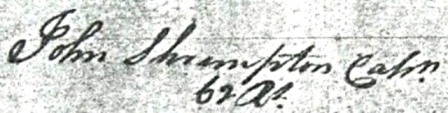
John Shrimpton Capn., 62 Rt., his signature from a regimental paylist dated Monkstown, Ireland, 3 April 1776
Nationality: English
Born: ca.1744
Regimental commission dates:
Lieutenant, 3 June 1767 (Lieutenant in the army 22 October 1761)
Captain-Lieutenant, 17 September 1773
Captain, 12 March 1774
Wounded: Battle of Hubbardton, 7 July 1777
Captured: Saratoga, New York, 17 October 1777 (Convention Army)
Retired: 4 September 1782
Died: "suddenly" at Brampton Park, Huntingdonshire, 28 March 1787
The ironically-named John Shrimpton served as the 62nd Regiment of Foot's elite grenadier company captain well before, during, and after the Northern Campaign of 1777. Commissioned a 2nd lieutenant in the 106th Regiment of Foot during the 7 Years War on 22 October 1761, Shrimpton was soonafter made a victim of post-war military reductions upon the disbanding of his regiment. He was able to obtain a commission in the 62nd Regiment in 1767 and from there began his slow rise in rank.
During the course of the Northern Campaign of 1777, Shrimpton's grenadier company served in the British grenadier battalion commanded by Major John Dyke Acland (20th Regiment). As such, Shrimpton, his two lieutenants (Arthur Blackall and Conolly Coane), and his men were removed from their parent regiment during the entire campaign and ended up fighting in separate actions of the same battle (and sometimes, fighting in different battles altogether), camping in different locations, and serving in different brigades. The grenadier company was not reunited with the regiment until the event of the Saratoga surrender on 17 October 1777.
Shrimpton was wounded during the course of the campaign at the Battle of Hubbardton, Vermont, on 7 July 1777. An account of his wounding was later recorded by Ensign Thomas Anbury (24th Regiment) in his Travels Through the Interior Parts of America (London: 1789):
After the action [Battle of Hubbardton] was over, and all firing had ceased for near two hours, upon the summit of the mountain…which had no ground any where that could command it, a number of officers were collected to read the papers taken out of the pocket book of Colonel [Ebenezer] Francis [the colonel of a Massachusetts Continental regiment killed in the battle], when Captain Shrimpton, of the 62d regiment, who had the papers in his hand, jumped up and fell, exclaiming, ‘he was severely wounded;' we all heard the ball whiz by us, and turning to the place from whence the report came, saw the smoke: as there was every reason to imagine the piece was fired from some tree, a party of men were instantly detached, but could find no person, the fellow, no doubt, as soon as he had fired, had slipt down and made his escape.
After the battle, the Advanced Corps set off in order to rejoin Burgoyne's main army. Anbury continues:
Major [sic: captain] Shrimpton, who I told you was wounded upon the hill, rather than remain with the wounded at Huberton, preferred marching with the brigade, and on crossing this creek, having only one hand to assist himself with, was on the point of slipping in, had not an officer who was behind him caught hold of his cloaths, just as he was falling. His wound was through his shoulder, and as he could walk, he said he would not remain to fall into the enemy's hands, as it was universally thought the sick and wounded must. Very fortunately, however, for them, they met with no molestation…
Shrimpton's slight wound allowed for him to continue the rest of the Northern Campaign; he fought in both Battles of Saratoga (19 September and 7 October 1777), surviving unscathed. He, along with both his lieutenants and the men of his company, surrendered with the rest of Lieutenant-General Burgoyne's army at Saratoga.
During his short period of captivity, Shrimpton was allowed to leave the Convention Army earlier than most of his brother officers (as early as July 1779); of the three officers of the regiment to have filed for leave in May 1778, his was the only one to have received a positive response from the rebels. This was in reaction to a letter written by Major-General William Phillips, Burgoyne's second-in-command, to rebel Major General William Heath, dated Cambridge, MA, 25 May 1778, in which Phillips asked that Shrimpton be allowed to go to Europe at once due to the "dangerous condition" he was in, resulting from the wound he sustained at Hubbardton. According to a subsequent letter written by Phillips to Sir Henry Clinton dated Cambridge, Massachusetts, 14 June 1778, while some other officers of the Convention Army were granted paroles so as to work at procuring their exchanges, Shrimpton was the only one who "goes by special permission."
By July 1781, he was recruiting men in England for the repatriated regiment. He remained captain of the grenadier company until his retirement in 1782. Shortly after leaving the regiment, Shrimpton was promoted to the rank of major of the Tower of London Garrison, and served as such until his death in 1787.
John Shrimpton was an alderman of the Town of High Wycombe in Buckinghamshire; a memorial to his life is displayed in the Church of All Saints in High Wycombe, the inscription of which reads as follows:
JOHN SHRIMPTON, Esqr.
Major of the Tower of London
and
Alderman of this Borough,
Died March the 28th, 1787, aged 45 Years.
He left the Character of a Brave Officer
In every quarter of the World,
and
as an Honest Citizen, an Generous Man, and a Steady Friend
was universally regretted
By this Town and Corporation.
According to the July-December 1793 issue of The Gentleman's Magazine, Shrimpton's 1787 death was brought about by the serious wound he received ten years earlier in the wooded mountains of Vermont, as he "died in consequence of a wound received long before in America."
Some later writings refer to an anecdote in which Major Acland, having been shot through the calves of both legs during the Battle of Bemis Heights (7 October 1777), requested that “Captain Shrimpton” help carry him off the field. The origins of this story come from Anbury's Travels, cited above, in which he states clearly that it was instead “Captain Simpson, of the 31st Regiment, who was an intimate friend [of Acland]….” The captain of the 31st Regiment's grenadier company, present in the Northern Campaign of 1777, was Noah Simpson, and the apparent similarity of both captain's surnames confuse some modern writers.