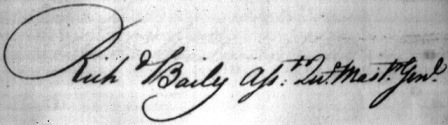
Richd Baily Asst: Qutr. Mastr. Genl., his signature on the "Embarkation Return of 447 German
Recruits and 60 Drafts for Regiments in Canada" dated Portsmouth, England, 2 June 1776
Nationality: English
Born: ca.1733
Age: unknown
Regimental commission dates:
Captain,
1 March 1776
Location during the Northern Campaign of 1777: Assistant Quarter Master General in England
Retired: 23 April 1783
Died: unknown
Wartime offered promotional opportunities which were otherwise very difficult to attain for men of the lower classes in the 18th-century British army, and those who were talented and had a mind for army economy were sometimes placed on a promotional track which was generally not granted in times of peace. Such was the situation in which Richard Baily found himself; he joined the Second Battalion, Royal Welch Fusiliers, as a private soldier during the Seven Years War (1754-1763), and quickly rose to the rank of serjeant due to his administrative abilities which fit perfectly the needs of that newly-formed wartime battalion. It was not long until Serjeant Baily was commissioned to the rank of second lieutenant on 26 January 1758, and on 22 July he secured the additional duty of regimental quarter-master. Promotion once again followed, and near the end of the war, Baily gained a first lieutenancy on 6 October 1762. While Baily's commissioned rank was placed on half-pay following the reduction of the British army after the Seven Years War, he remained as the regiment's quarter-master. He returned to commissioned service with the Royal Welsh Fusiliers on 25 December 1770 was again made a first lieutenant in the regiment. As such, Baily served with the Royal Welch Fusiliers in Boston during the beginnings of the American War for Independence, although it appears that his staffing duties kept him safe and away from the field of battle. In December 1775, he was recalled home to serve as an army assistant quarter master general.
On 1 March 1776, Baily was promoted to a captaincy in the 62nd Regiment of Foot and was assigned to the command of the regiment's junior additional company, a duty which would normally have kept him engaged in recruiting new men for the regiment. This was perhaps ironic since, of all the officers of the 62nd Regiment at the time, Baily had the most fighting and campaign experience.
As an assistant quarter master general in England, Baily had the particular duty of assisting "in providing and forwarding Camp Equipage, Necessaries, Stores, &c to the Army for the Campaign 1776 and after having completed it, received Directions from the late Secretary at War and Adjutant General to remain in England upon that duty" (WO 34). The Parliamentary Register, or History of the Proceedings and Debates of the House of Commons (London), record passage of bills by which Baily received 182.10.0 on 20 March 1778 for 365 days pay, covering 11 March 1777 to 10 March 1778 inclusive for “superintending the embarkation of parties, horses, stores, &c. for the armies in North America.” On 20 April 1780, Baily was paid 241.1.2 “for expenses in superintending the embarkation of parties, camp equipage, &c. from 11th March 1779 to 10th March 1780.” He was again paid 182.10.0 “for superintending the embarkation of parties, stores, &c. for the armies serving abroad [from 11 March 1780] to 10th March 1781.” Clearly, these duties kept him very busy and it appears that he did not serve with his company.
After the 62nd Regiment's repatriation to England in 1781, Baily was listed as being on General Edward Mathew's leave, due to his continued duties as a "Deputy Commissary" and he remained on leave from the regiment during its extensive reorganization period. Baily was breveted to the rank of major in the army on 12 June 1782, and resigned his regimental commission in 1783.
Despite his own consistent surname spelling, Baily was often listed as “Bailey” in period records.